SEO Content Marketing Tips: How to Attract and Engage More Recruitment Clients with Web Content

SEO Content Marketing Tips: How to Attract and Engage More Recruitment Clients with Web Content

SEO Content Marketing Tips: How to Attract and Engage More Recruitment Clients with Web Content

Content Marketing Tips

Online ads allow you to reach out to prospective clients who are actively searching for your recruitment services. Many recruiters use these marketing tools to connect with employers and candidates. However, online ads are not the only ones that can make people trust your recruitment agency and help you establish a strong presence in the market.

You have an important marketing goal: to attract more leads and increase conversions. However, completing these tasks can be challenging, especially with stiff online competition these days.  Fortunately, you can help your recruitment agency stand out by using web content to ensure great brand position and create an excellent user experience.

To ensure your success, your content strategy should focus on leading your readers into the sales funnel by:

  •   Making people aware of your brand
  •   Generating interest in your products
  •   Offering a convincing reason why prospects should choose your recruitment services
  •   Eliminating potential objections

Many recruiters write a few blogs to promote their services. However, that’s not enough. Don’t focus solely on selling what you offer. Instead, you should create content that will educate and provide value to readers.

Also, you must use your web content to answer questions your potential clients have in mind. Here are a few content marketing tips to help you get started.

1.   Identify your target readers and ideal clients

You can’t write excellent content without knowing your target readers. Before anything else, you should define your client personas first.

Identify your ideal recruitment clients based on the following criteria:

  •   Age
  •   Education
  •   Social background
  •   Personality traits
  •   Motivation
  •   Possible influences in their decision
  •   Source of information that they trust
  •   Income level
  •   Location

When people look for your products online, find out if they:

  •   Use a search engine.
  •   Find you on social media.
  •   Go directly to your website. 

2.      Define your value proposition

You have established the identity of your ideal clients. Now, it’s time for you to answer concerns from their perspective – What benefits can I receive from this service?

This is a critical question that you need to answer satisfactorily. Also, make sure that your web content tells the audience what your company is all about. You need to prove that your recruitment services are different from the rest.

Consider adding reviews and testimonials from satisfied employers and job seekers. They are the kind of content that can help attract prospects since they provide real-life experiences. Besides reviews and testimonials, you should also offer tips and other useful information about recruiting new employees or finding job placements. 

3.      Build trust with your online visitors

Many visitors are not impressed with scripted dialogues and digitally enhanced photos. They want to see real and authentic images. Consider uploading pictures of satisfied clients to build trust and rapport with your prospects. 

4.      Select the best content type for your target audience 

It is vital to select the content type most suited for your target audience to get the best results. Consider the following:

  •   Blogs and infographics
  •   Case studies and white papers
  •   Podcasts and videos
  •   Email campaigns
  •   Brochures, newsletter or FAQs

If possible, add more interactive content to your website. Recent trends show that videos have a higher engagement rate than other types of web content. A content marketing report discovered that more than 80% of visitors prefer interactive content rather than static ones. Also, almost the same number of people could remember a brand’s message when delivered interactively.

However, regardless of your distribution platform, the content theme should not deviate from your overall marketing strategy. 

5.      Promote and share your content

Here’s one of the most vital content marketing tips you shouldn’t overlook. After you finished creating quality content, you’re now ready for its publication and promotion. Make sure to choose the best channel to reach as many potential recruitment clients as you can. There are multiple means of distribution to choose from, such as:

  •   Social media sites
  •   YouTube
  •   Discussion forums, such as Reddit
  •   Influencers

Publish your content on platforms where most of your target audiences go. This is how you lead them to your sales funnel. Use analytics to identify which platforms provide the most traffic.

Take Away

Building a connection with your audience is an effective online marketing strategy, but that’s not enough. You need to continuously maintain trust and rapport by creating and delivering a personalised user experience through web content.

Remember, the primary reason for creating content is to add value to your recruitment site. Create valuable content that’s compelling enough to convert web visitors into leads or even clients or members of your talent pool.

Effective content strategies require the skills of an SEO professional. They have the experience and knowledge to choose the right content to write and the platform from which you can distribute it. If you need assistance with content marketing, we at Recruitment Traffic are happy to help. You don’t have to waste time and effort to come up with a content marketing strategy that will help you generate more traffic and leads.             

Drive Your Recruitment Business Towards The Best Results.

Talk to us about how we can help.

20A-30 Abington Street, Northampton, Northamptonshire, NN1 2AJ

Bing SEM Expert Logo

Recruitment Traffic is a trading name of Situnario Ltd. © 2007 - 2021 Situnario Ltd. All rights reserved.

How Can Recruiters Personalise a Candidate’s Experience

How Can Recruiters Personalise a Candidate’s Experience

How Can Recruiters Personalise a Candidate’s Experience

personalise a candidate's experience

Recruiters should view marketing as a means of making personal connections. You should encourage people to follow you on social media and chat about your service with their friends.

What recruiters should know about personalisation?

If you’re a candidate, which do you prefer: a generic mail or a personalised offer? Most will pick the second one since it means that you took the time to learn and understand their needs. As a recruiter, using the second approach will make your job offers stand out.

Consider this Forbes article regarding millennial jobseekers.  According to the report, millennials are attracted to companies that share their philosophy. Also, while compensation is important, many millennials are willing to start with less pay to attain their dream job. This means making sure that your job posts will reach the right people. You can make this goal easier to achieve if you personalise a candidate’s experience.

Five steps for personalising your recruitment campaigns

You don’t need to create unique content for each of your potential candidates. A template will suffice. However, the process involves more than inserting a name in an email greeting. Here are the five steps to personalising your recruitment campaign.

1.   Develop your client’s brand

Strengthen your client’s image by writing a persuasive message to attract your target candidates. Also, include a value proposition sufficient enough to engage prospective job seekers. Incorporate that message in your: 

  • Career pages
  • Job postings
  • Website

2.       Analyse the data 

You must gather enough information about your ideal candidates. For example, you can ask the following questions: 

  • Where does your target audience look for jobs?
  • What kind of platforms do they use?
  • What is their motivation for accepting your job offer? 

3.       Segment your audience 

Segregate your candidates using various factors, such as behaviour, interest or the kind of work they do. Remember, the message you convey to executives is different compared to sales or IT personnel. It’s also essential to create separate messages for your candidates during the different phases of the recruitment process.  

4.       Connect with them 

As a recruiter, you’re going to reach out to different kinds of job seekers, which can range from college graduates to professionals. You can get in touch with your target audience through networking, social media, and referrals. You could also reach out directly to promising candidates even if they are not seeking the vacant position. 

5.       Engage with the candidates 

After making the first connection, you can now strengthen that interaction through various means, including:

  • Emails
  • Social media
  • Phone calls

You can also inform prospective candidates about vacant positions through newsletters or social pages.

Know your candidates

The best way to convince suitable candidates to take your job offer is to address their needs, as well as the problems and fears they have about the position. Here are the most common methods for addressing their concerns.

Provide all the relevant information in the job post

Content often plays an essential part in recruitment. In your job post, make sure that it has all the information a potential candidate will need. Listing a job offer is not enough. You also need to include the details that will assure them of your client’s trustworthiness.

Make the job post easy to find

It’s common nowadays to create fancy job titles, such as ‘Client Engagement Consultant’. However, if you do so, that position may not appear to candidates searching for ‘Accounts Manager’ positions (they are the same). When posting vacant positions, always consider how job seekers search for them.

Streamline the application process

A 30-minute online application process may seem fine for your client. However, you’ll need to convince candidates why they should invest that much time. It won’t be easy, especially if you’re targeting high-quality candidates who are currently employed. Since they are still in the application stage, asking them to send a resume will do. It will speed up the process while allowing you to obtain as many candidates as you can.

Consider your candidate’s time

Attracting and engaging prospective candidates takes effort and time. Don’t let that go to waste by dragging out the interview.

Often, many of your job seekers are currently employed. So consider setting the interview in a convenient location before, after working hours or on lunch breaks. Such a gesture will show the candidates that you value their time.  

Build your candidates’ personas

 To better personalise a candidate’s experience, you should consider creating candidate personas. Candidate personas represent the ideal employee for your client. It’s a representation that allows you to determine if a job seeker is qualified for the vacant position. In addition, it can help you:

  • Write better job descriptions
  • Choose the best channel to recruit target candidates
  • Select the strategies that will obtain suitable talents

How to create a candidate persona

1. Research

You need to use actual and relevant data. You can get them from your client and their employees. Obtain their input to create a picture of their ideal employee. Some of the questions you can ask include:

  • What makes the job appealing?
  • What motivates them to work for the company?
  • What is the corporate culture?
  • Where do employees spend their time during breaks?
  • What skills do employees need to excel in the position?
  • What are the primary career goals of the employee?

To obtain accurate data, you’ll need to ask three specific groups – the client’s employees, hiring managers and the candidates themselves.

2. Analyse your research data

This process is critical, especially if you’re creating more than one persona. It allows you to detect common or unique trends for every role. For example, you may find that all sales and marketing personnel are result-driven with college backgrounds. You can now include this detail in all sales and marketing personas.

3. Create a persona story

After the research and analysis, you’re now ready to build your persona. Consider the following as an example:

Position: Marketing manager

Educational background: Has a degree in digital marketing

Experience: Worked in the same role for two to five years in a rival company

Skills: Content marketing and social media management

This is a simple example of a candidate persona. You can create a more elaborate one depending on your client’s needs.

Take Away

It’s now essential for recruiters to make the candidate’s experience a personal one. However, this doesn’t mean that you have to create unique content for every candidate. It’s enough to show your candidates that you value their time and effort to reach out to you. Personalising your services is also beneficial to your recruitment business. It allows you to build a candidate persona for your client’s vacant job positions. By creating a representation of the ideal employee, the recruitment process is shortened, and the best candidates can be selected.

Personalising your recruitment service and building candidate personas can be a time-consuming and challenging task. If you need help, give us a call here at Recruitment Traffic. We can help personalise your recruitment SEO and Google Ads.

Drive Your Recruitment Business Towards The Best Results.

Talk to us about how we can help.

20A-30 Abington Street, Northampton, Northamptonshire, NN1 2AJ

Bing SEM Expert Logo

Recruitment Traffic is a trading name of Situnario Ltd. © 2007 - 2021 Situnario Ltd. All rights reserved.


YouTube SEO for Recruiters:  Tips for Better-Performing Videos

YouTube SEO for Recruiters: Tips for Better-Performing Videos

YouTube SEO for Recruiters:  Tips for Better-Performing Videos

YouTube SEO

Did you know that YouTube videos can help recruiters like you attract potential clients and candidates? Yes, that’s right! YouTube videos are not just for travel vloggers or influencers who promote all sorts of products online. Recruiters can also use this video-sharing site to establish authority, build an online presence, and most importantly, generate traffic and leads to their respective sites.

With YouTube being the most popular social platform in the UK and having hundreds of millions of active users every day, it enables you to inform and engage your target audience with excellent efficiency. Want to help job seekers craft an impressive CV? Or perhaps you want to offer some tips on how business owners can help new hires acclimate to their new surroundings? Whatever the case may be, you can harness the power of YouTube videos to showcase your recruitment expertise and urge your audience to enlist your services. 

How to Get Better Results on YouTube

YouTube’s algorithm recommends most of the videos people watch on the site. As such, if you want your videos to be more popular and visible, you should know to optimise them for YouTube SEO. Here are some tips to help you get started.

1. Perform keyword research

As with general SEO, you should incorporate keyword research into your YouTube strategy. This will help you determine the most relevant keywords for your video titles and descriptions. When performing keyword research, make sure that it jives with the one you had for your recruitment site’s SEO.

You can use YouTube’s Search Suggest feature when conducting keyword research. You can also look at the popular videos in the recruitment niche to identify the search terms and phrases your fellow recruiters are targeting.

2. Go for long-tail keywords

Similar to your Google Ads and general SEO strategies, you should avoid targeting popular keywords as much as possible. While these keywords often attract the biggest audiences, they can be challenging to rank for. Competition for them can be fierce, and if you use them in your video titles or descriptions, you might find your videos at the bottom of search results.

Instead of gunning for popular keywords, go for their long-tail counterparts instead. Long-tail keywords can provide you with better opportunities to stand out. At the same time, they allow you to direct your target audience to specific and more relevant pieces of content.

For instance, let’s say you want to create a tutorial video on acing job interviews. Instead of using the more general search phrase “job interview tips,” you can go for something specific, such as “how to pass job interviews for accountants.”

3. Write compelling video titles

Similar to when writing headlines for your blog posts, you must choose compelling titles for your videos. Choosing something catchy and engaging for your video titles will help capture your audience’s attention. It would also encourage them to click and watch your videos.

Keep your video titles short and sweet, preferably 60 characters or fewer. Otherwise, they would be automatically cut off in search results. Also, make sure to add your target keywords to make your videos more searchable and relevant.

4. Don’t forget to optimise your video descriptions

YouTube gives you a maximum of 1,000 words for your video description. However, viewers will only see the first two or three lines unless they click on “Show More.” For this reason, you should place your target keywords, essential links, and other critical information in the first few sentences of your description.

You don’t necessarily have to write a long description and meet the maximum word count. What you can do instead is to use the remaining words to target other keywords to improve your YouTube SEO. You can also add more text to further encourage your viewers to check out your recruitment site and/or enquire about your services.

5. Pick the right category

Don’t forget to choose the right category once you’re done uploading a video. You can do this by clicking on “Advanced Settings.”

Choosing the right category will help ensure that your video will be grouped with those that have similar topics. Also, it prevents your content from being placed in random playlists, thus, ensuring that it will reach the right audience.

6. Use relevant tags

Similar to categories, tags tell YouTube which video group it should place your videos. At the same time, it enables you to target relevant keywords. This is why you should add the most relevant tags to your videos.

7. Avoid videos that are either too long or too short

Similar to when writing blog posts, make sure that your videos are not too long or too short. They should be long enough to provide value for your viewers but not too long to bore them.

To determine if your target audience is happy with the existing length of your videos, take a look at your video stats. Are people skipping your videos? Or are they only watching up to a certain point? Whatever the case may be, you should make the necessary adjustments to match your audience’s viewing habits. 

Boost the Performance of Your Recruitment Videos

With YouTube being the most popular social platform in the UK, adding it to your arsenal of online marketing tools can help you attract potential clients and job seekers. Follow the tips discussed above to get the results you’re expecting.

If you need help optimising videos and other web content for search engines, we at Recruitment Traffic are happy to assist you. Please speak with us today and let us show you what makes our recruitment Google Ads and SEO services award-winning.

Drive Your Recruitment Business Towards The Best Results.

Talk to us about how we can help.

20A-30 Abington Street, Northampton, Northamptonshire, NN1 2AJ

Bing SEM Expert Logo

Recruitment Traffic is a trading name of Situnario Ltd. © 2007 - 2021 Situnario Ltd. All rights reserved.

What is Brave Browser?: What Recruiters Must Know about This Ad-Free Web Browser and Search Engine

What is Brave Browser?: What Recruiters Must Know about This Ad-Free Web Browser and Search Engine

What is Brave Browser?: What Recruiters Must Know about This Ad-Free Web Browser and Search Engine

What is Brave Browser

As a recruiter, it’s essential that you’re familiar with the web browsers and search engines your prospects are using. This way, you can better optimise your website to meet your visitors’ specific browsing needs and provide them with a better user experience. 

These days, there are many new web browsers, many of which have built-in search engines. These include Brave, a new browser and search engine said to provide a safer alternative to Google. So, what is Brave browser and what makes it different from the search giant? 

A Closer Look at Brave Browser and Search Engine

Brave web browser rose to fame because of its ability to block ads. It recently announced the launch of its own search engine as part of its efforts to challenge Google and make a mark in the highly lucrative search market. 

Going against Google is no easy feat. Processing more than 92% of online searches worldwide, the search giant certainly has the lion share. Bing followed in second place with a measly 2.7%. However, the people behind Brave are confident that they have a chance to claim a more significant share of the market as Google scrambles to protect its users’ data privacy while governments intensify their antitrust scrutiny of the search giant. 

Focusing on the privacy of its users, Brave will have its own search engine in the later part of 2021. On its first run, it would automatically remove ads and delete code that can track a user’s online activity. This service is similar to those offered by other browsers, such as Apple Safari, Mozilla Firefox, and Microsoft Edge. 

Once the initial run is over, the ads will start showing up. However, users will have the option to continue having an ad-free search experience by paying up and joining Brave’s ad system. Besides eliminating traces of their online behaviour, this system will also provide them with a percentage of ad revenues through Brave’s cryptocurrency. Publishers of web content and YouTube or Twitch videos can also sign up to receive payments from Brave users. 

How Brave Works

Now that you know the answer to the question “What is Brave browser?” the next thing you should know is how its new search engine works. In early 2021, Brave acquired Tailcat from Hubert Burda Media in Germany. Unlike Google, Tailcat could deliver search results without tracking users’ online behaviour or asking them to create a profile. Brave used this technology as the foundation of their new search engine. 

Search engines require many resources to collate data, build an index of data, and then deliver accurate search results to users. This is why most of them would re-use search results from Google. Breaking away from the norm, Brave said it would not piggyback off the search giant. Instead, it would rely on the users of its search engine. 

People who would join Brave’s data-sharing system will provide information about the things they search online and the results they click on. Then, the search engine would utilise the data it receives to refine its search capabilities and provide the answers its users are looking for. 

To ease concerns over the system’s potential data privacy issues, Brave Chief Executive Brendan Eich assured everyone that the data provided by users, called “clickstream” data, would be anonymised. This is to ensure that users would not be identified over the information they share online. 

Utilising clickstream data to provide search results is nothing new. Microsoft did it with Bing a few years ago, which earned it a lawsuit from Google for allegedly copying its search results. However, similar to Microsoft, Eich believes using clickstream data in this manner is neither wrong nor unethical. He said today’s machine learning systems do not simply copy search results from Google. They also aggregate and optimise them. 

Eich also argued that Brave’s search engine is a machine learning system that focuses on its users. Unlike Bing, it would not “blindly scrape” and copy search results from Google. However, he admitted that their search engine still has some ways to go. They would need to convince more people to start using Brave web browser and search engine to enhance their capabilities. The more clickstream data they can obtain from users, the more accurate the search results would be. 

Indeed, challenging Google is an uphill climb. However, Eich is confident that more people would see Brave as a better and safer alternative to Google. Since Brave browser’s launch in 2016, its user base has stood at 32 million people. Eich and his team are optimistic that they can reach their target of 50 million users by the end of this year. 

Stop Focusing on Google!

With lots of web browsers and search engines emerging to challenge Google, focusing solely on the search giant is not exactly a wise move. As more people look for safer and less intrusive alternatives to Google, it is your job as a recruiter to optimise your site for other major search engines. This way, you can enjoy better online visibility and provide job seekers and employers with outstanding user experience regardless of the online platforms they are using to find and access your site. 

Do you need help optimising your recruitment site for various web browsers and search engines? We can help! Recruitment Traffic has a highly experienced SEO team ready to provide you with the expert assistance you need. Please speak with us today and let us create an SEO strategy tailored to your specific requirements. 

Drive Your Recruitment Business Towards The Best Results.

Talk to us about how we can help.

20A-30 Abington Street, Northampton, Northamptonshire, NN1 2AJ

Bing SEM Expert Logo

Recruitment Traffic is a trading name of Situnario Ltd. © 2007 - 2021 Situnario Ltd. All rights reserved.

What is SEO Content? Hints and Tips on Creating Search Engine-Friendly Content for Recruiters

What is SEO Content? Hints and Tips on Creating Search Engine-Friendly Content for Recruiters

What is SEO Content? Hints and Tips on Creating Search Engine-Friendly Content for Recruiters

what is seo content

You can pour your heart and soul into creating the best and most comprehensive guide on finding a job or hiring the perfect candidate. However, it won’t necessarily guarantee that it will drive a significant amount of traffic to your recruitment site. To generate the results you’re expecting, it’s also vital to optimise your content for search engines. 

SEO Content Explained

If you’re new to the SEO game, you’ve probably come across the term “SEO content” many times during your research. But what is SEO content exactly? What makes it different from your run-of-the-mill web content or blog post? 

As the name implies, SEO content is a piece of web content written to help you generate traffic for your site. The ‘SEO’ in SEO content refers to search engine optimisation, the process of optimising your site for search engines, such as Google. 

As a recruiter, creating exceptional SEO content is essential to your overall online marketing strategy. Besides helping you attract organic traffic, it enables you to: 

  • Find leads for your recruitment business.
  • Rank on search engines.
  • Establish a significant online presence.
  • Build credibility and industry authority. 

How to Write Quality SEO Content

Here are the steps to writing search engine-friendly content: 

1. Identify your preferred content format

When writing content for SEO, you’d want to have a variety of options to choose from. Creating diverse content enables you to target different segments of your audience. Here are a few examples: 

  • Articles/blog posts – you can write about the latest news in your industry or provide a quick guide on a wide range of topics related to recruitment.
  • Pillar pages –these are often more comprehensive and significantly longer than articles or blog posts.
  • Infographics – they combine text and visual content to educate and entertain your audience. Highly shareable, they are a great help when presenting data-heavy information.
  • Videos – making up a huge chunk of search results, they are a great addition to your repertoire. 

2. Perform keyword research

Now that you know the answer to the question “What is SEO content?” you’re probably itching to write a post for your recruitment site. However, before you do that, you should determine the keywords you need to use in your content. You can do this through keyword research

Keyword research is an essential SEO process as it helps you determine more than the keywords you need to target. It gives you insights into the type of content that appeals to your audience. More importantly, it allows you to get to know job candidates and employers better by giving you a glimpse into their mindset, thoughts, worries, and fears. 

3. Understand search intent

With Google’s recent algorithm updates, adding the most relevant keywords to your content is not enough to give you good search rankings. You should also understand your audience’s search intent, or what motivates them to perform an online search. If your content doesn’t match your audience’s search intent, it is less likely to rank on search engines. 

To determine your drives your audience to perform a specific online query, take a look at the top-ranking results of your target keyword and analyse the following: 

  • Content type – Are the top-ranking search results blog posts or articles? If most of the results are landing pages or something else, you should perform keyword research and choose a different topic or keywords.
  • Content format – Find out what type of posts rank well. Are they listicles, videos, how-tos or something else?
  • Content angle – Check out the page titles or headlines to determine the type of person searching for your target keywords or topic. This will help you determine what they need, whether it’s a quick solution or a more comprehensive guide to solving a specific problem. 

4. Create your content

What comes next after knowing what is SEO content and doing all the preliminary research? Once you have identified the topic you want to write about, the keywords you want to rank for, and the type of content format you want to use, it’s time to create SEO content. To make the process much easier for you, here a few tips you should consider: 

  • Create an outline to make your post more coherent.
  • Write as you speak. Using a more conversational tone will make your post less stiff and more engaging.
  • Always edit and proofread your content after writing. It will reflect poorly on your recruitment business if your blog posts are filled with grammatical and spelling errors.
  • Include images in your posts to make them more attractive and engaging.
  • Make your posts more reader-friendly by breaking up long texts into smaller paragraphs and using subheadings/bullet points. 

5. Don’t forget to write a meta title and description

Google and other search engines don’t just rely on the text on your webpages to determine what they are all about. They also consider your pages’ meta tags. As such, make sure to write a compelling title and description before posting your content. 

Besides helping your content rank on search engines, meta tags can also help increase your conversion rate. Because your meta title and description show up on search result pages, you can use them to explain to your audience why they should visit and check out your post. 

Optimise Your Recruitment Content for SEO

Creating content is a great way to demonstrate your recruitment expertise and earn your target audience’s trust. However, creating well-written content isn’t enough to get you on top of search result pages. It’s also crucial to write SEO content if you want to obtain more traffic to your recruitment site. Follow the tips discussed above to make your content more search-engine friendly. 

Don’t have the time to create SEO content? We can take this task off your hands! Besides creating SEO content for you, we at Recruitment Traffic can also provide you with a wide range of SEO solutions to make your recruitment site more visible online. Speak with our team today and let us show you how we can help.

Drive Your Recruitment Business Towards The Best Results.

Talk to us about how we can help.

20A-30 Abington Street, Northampton, Northamptonshire, NN1 2AJ

Bing SEM Expert Logo

Recruitment Traffic is a trading name of Situnario Ltd. © 2007 - 2021 Situnario Ltd. All rights reserved.

What Is Cumulative Layout Shift (CLS) and Why Recruiters Like You Should Care?

What Is Cumulative Layout Shift (CLS) and Why Recruiters Like You Should Care?

What Is Cumulative Layout Shift (CLS) and Why Recruiters Like You Should Care?

Cumulative Layout Shift
As you may know, Google considers many factors when identifying a website’s search ranking. These include a site’s freshness, security, and content quality, amongst many others. This is why if you want your recruitment site to land on top of search result pages and generate high-quality traffic and leads, you must know how to optimise it for Google’s various ranking factors.

The search giant doesn’t reveal all the ranking factors it uses. However, there has been a buzz lately that Google will add another one to its ranking factors in 2021. It is called Cumulative Layout Shift or CLS.

What is CLS and, as a recruiter, why do you need to understand how it can affect your site? 

What You Should Know about CLS

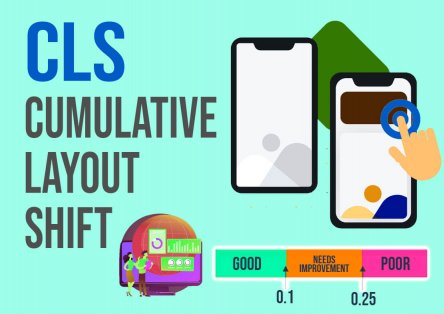
In a nutshell, CLS refers to the unexpected changes or shifts that occur on your site’s elements as your webpages load. The page elements that can experience changes are: 

  • Fonts
  • Web images
  • Videos
  • Buttons
  • Contact forms
  • Other web content

If you want your recruitment site to rank high on Google, you should minimise CLS as much as you can. Failure to do so could lead to a poor user experience. It could also give Google the impression that your website has coding problems.

Common Causes of CLS and How to Fix Them

According to Google, certain page elements can contribute to CLS. These are:

1. Images and videos without exact dimensions

To prevent web images and videos from causing CLS, you need to indicate their height and width dimensions in the HTML. In case you want to upload responsive images or videos with different sizes, ensure that they have the same aspect ratio. You can use this tool to calculate their aspect ratio.

2. Ads, embeds, and iframes without precise dimensions

Running ads is a great way to entice web visitors into signing up for your recruitment services. However, if they are not embedded correctly, they could cause CLS. If you have ads without exact dimensions, style them in a way that people visiting your site can immediately see them even while your webpage is still loading. For example, you can set a certain height and width for the div so your ads will be contained within its specific dimensions.

Ads that fail to load inside a web element, such as a banner ad, can also contribute to CLS. To fix this problem, fill the space with an alternative banner ad. You can also use a placeholder image so the web element won’t show up empty as the page loads.

3. Dynamically injected content

Dynamically injected content is web content that is added to your webpage on auto-pilot. For example, let’s say you want to add a YouTube video to your recent WordPress blog post. WordPress will automatically display the video in question as an embedded object when you add the link to your page.

4. Web fonts

Apart from certain types of web content, downloaded web fonts can also contribute to a cumulative layout shift. Fonts that can cause FOIT (flash of invisible text) and FOUT (flash of unstyled text) are particularly notorious for this. To prevent CLS, use rel=”preload” on the link for the web font you want to add to your webpage.

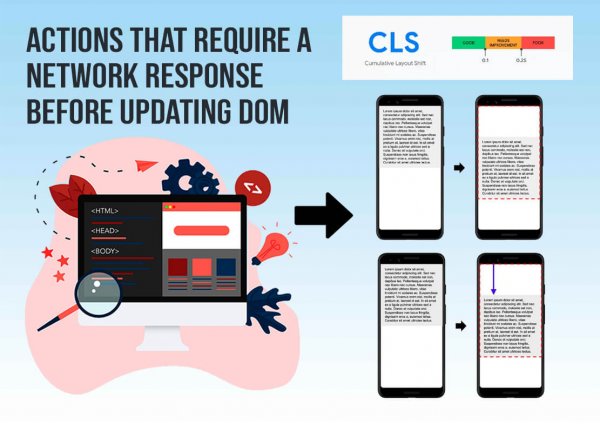
5. Actions that require network response

Google revealed that CLS could also happen during web development. It might not be too noticeable since many of the page elements needed to render a webpage have been downloaded onto the browser’s cache already. This is why it helps to have a solid understanding of CLS so you can catch it during web development.

Calculating and Measuring CLS

Two metrics or events are used when calculating CLS: impact fraction and distance fraction.

1. Impact fraction

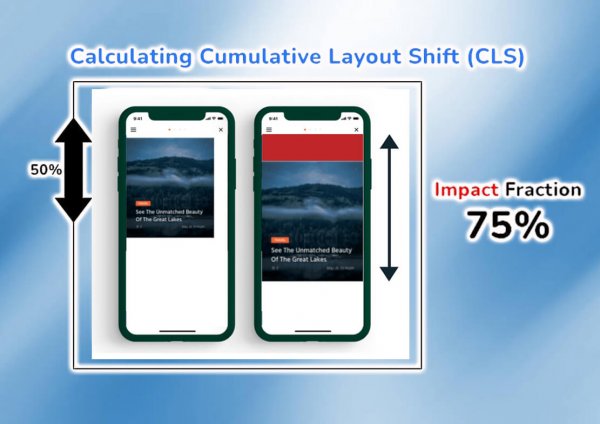
Impact fraction helps you determine how much space an unstable web element takes up in the viewport. The viewport refers to what you see on the screen of your mobile device. 

To help you better understand impact fraction, here’s a quick example. Suppose a page element takes up 50% of the viewport. Then, it moves by 25% when the page is being loaded. Combining these two values gives you a 75% impact fraction, which is 0.75 when expressed as an impact fraction score.

2. Distance fraction

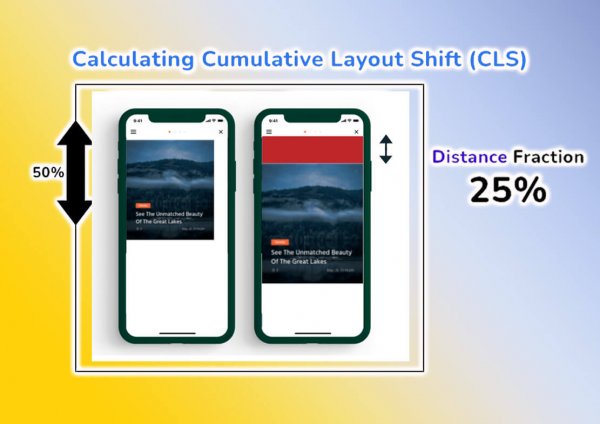
Distance fraction, meanwhile, refers to the amount of space that a web element has moved from its original position to its final position.

Based on the example given above, the page element’s location changed by 25%. When expressed as a distance fraction score, it would be 0.25. If you want to determine the page’s total cumulative layout shift score, multiply the impact fraction score by the distance fraction score. Therefore, 0.75 x 0.25 will give you 0.1875.

There are two ways to measure CLS, according to Google. They are in the lab and in the field. Measuring CLS “in the lab” involves simulating a web visitor as they download a webpage. Google itself uses a simulated Moto G4 to identify the CLS score of a website under such circumstances.

While you don’t necessarily have to do the calculations yourself, it helps to determine the CLS score of your webpages, especially during the development stage. It allows you to identify the adjustments you need to make before publishing your pages to ensure a good user experience.

Preparing for CLS is Vital

Having a deep understanding of CLS is indeed a huge help when it comes to improving your recruitment site’s search rankings. With Google set to implement its new ranking factor next year, you must know how to make the necessary preparations to achieve excellent placements on Google search results and obtain high-quality traffic.

Do you need help preparing your site for CLS? We can assist you. At Recruitment Traffic, our team of Google experts can provide you with the solutions you need so you can give your web visitors an excellent user experience and, subsequently, increase your site’s search rankings. Contact us today, and we’ll create a bespoke plan just for you.

Drive Your Recruitment Business Towards The Best Results.

Talk to us about how we can help.

award logo 2022

20A-30 Abington Street, Northampton, Northamptonshire, NN1 2AJ

Bing SEM Expert Logo

Recruitment Traffic is a trading name of Situnario Ltd. © 2007 - 2021 Situnario Ltd. All rights reserved.